Skip to content
Brendan Da Costa

Content Writer & Strategist. Blogger & Author.

Books & stories

The first page.

Choose a story and read the opening.

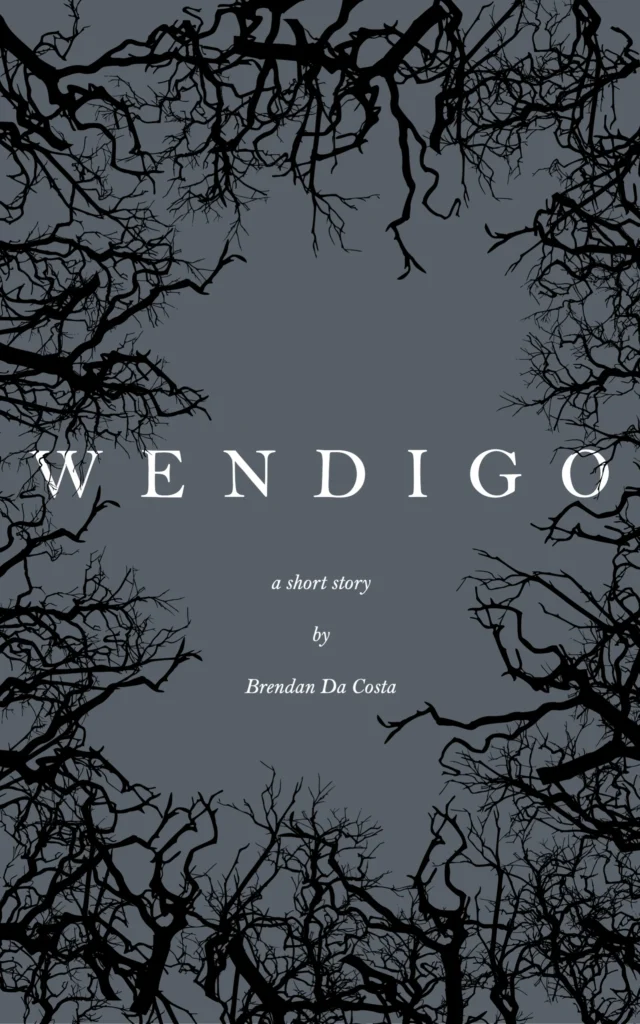
Wendigo by Brendan Da Costa, book cover.

Historical horror

Wendigo

A haunting reimagining of the Lost Colony of Roanoke, where ambition, greed, and faith collide with something waiting beyond the settlement.

Roanoke, 1587

~ I ~

“He will not last the winter.”

Mary spoke into the folds of the sheets, hunched over her son’s body. If the boy still drew breath, Henry couldn’t tell. He stayed in the threshold, leant against the jamb; his arms folded across his broad chest. The late-autumn sun broke in as a block of light through the solitary window on the far side of the room. Where the block fell was on the midsection of the bed, on Mary’s head as it rested atop their son’s unmoving stomach. But the light did not fall as a blessing. It was a dark light, a bleak light; false and oppressive — a leaden weight of sunbeams that crushed that which fell beneath it.

Henry pushed himself off of the jamb with a strong yet subtle nudge of his shoulder. “I will lead us in prayer.”

Mary whipped around from the bed, arresting Henry in her gaze before he could step out of the threshold into the room. Her eyes were red, not with sadness but with rage — rage unlike Henry had seen in his wife.

“Prayer?” she seethed. “I have prayed,” the rage boiled out of her mouth as over the rim of a pot and scalded her own eyes and she recoiled from the burn. When she opened her eyes again, they were supplicant eyes, wet eyes, white and wide eyes and she dissolved into deep, guttural sobs, drawn up from her belly. “I have prayed, Henry,” she pleaded. “I have prayed for my son but for my sins the Lord has not answered. We are forsaken, Henry!” She collapsed again on the boy’s stomach. “We are forsaken in this land! Whence have we come, Henry?” she wailed, roiling over the bed, over her son. Then, all of a sudden and as if possessed, she stopped and stiffened and sat up straight in her chair, keeping her arms across the boy’s chest that moved up and down in uncertain, uneven fits. She turned to Henry once again, stiff and straight and with a disquieting composure — disquieting by its composure. “This is the Valley of Hinnom,” she said, as of having made a discovery of the plainly obvious. “This is Gehenna and we shall be consumed with unquenchable fire.”
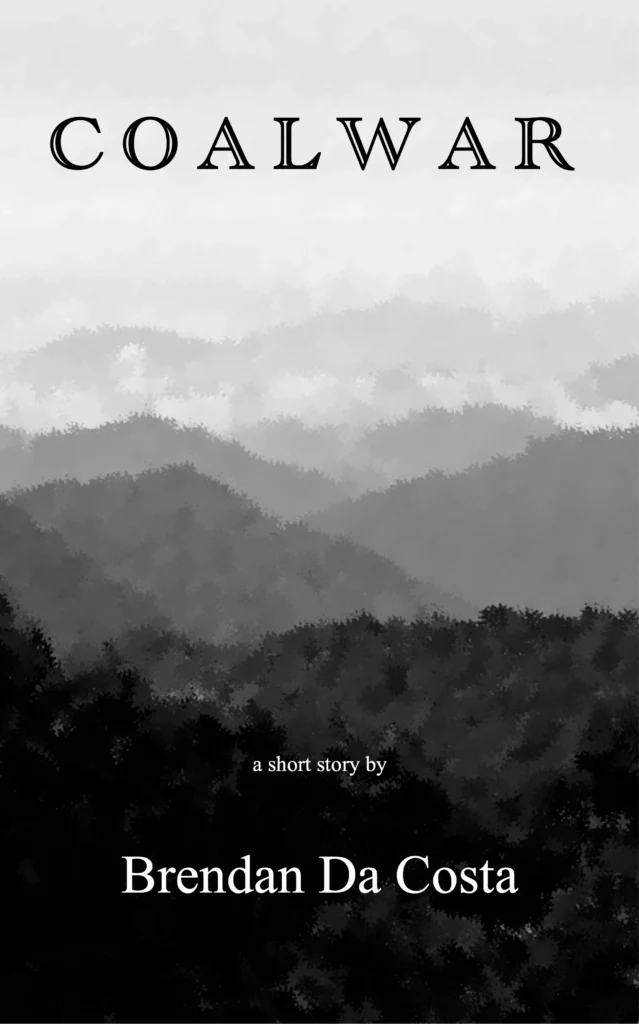
Coal War by Brendan Da Costa, book cover.

Historical fiction

Coal War

In the coalfields of Appalachia, the struggle between working families and industrial power turns into a fight for dignity, survival, and a future.

[1]

James opened the door and the cool Appalachian air followed him in. The draft swept across the small kitchen’s floor and crept underneath the door to Oscar’s room. Carried in the draft was the acrid smell of the coal mines. Oscar’s nose didn’t crinkle at the pungency for he had good associations with the scent of coal; it was the scent of his father’s homecoming, a familiar and heart-warming scent. He stood up from the ground where he had been playing in the fading light coming through the small window.

His father had only stepped through the door when Oscar burst into the kitchen. James looked up from his boots at his son and then over at the sink where his wife, Maude, had been peeling a potato. There was a question in the look that Maude gave her husband when he entered and an answer in the way that James hung his head when he closed the door behind himself. Oscar hadn’t noticed the silent conversation or sensed its sombre tone over the excitement in his own mind.

He ran across the kitchen floor — no more than four or five steps even with his tiny legs — and slammed into his father and wrapped his arms around his waist.

“No, boy,” James gripped Oscar’s shoulder with one firm and bony hand and peeled him off of his body. He looked down at the black smudge across Oscar’s face and shirt from where the boy had pressed his little body against his coal-stained clothes.

“Now look,” he said, “your mother will have to clean that. Don’t you think she has enough of a day’s work already?”

Oscar looked across at his mother. Maude saw the plea and the apology in the boy’s eyes and she reached out her hand towards him. “Come,” she said and her voice was gentle.

Oscar dropped his head to hide his embarrassment as he walked, slowly now, towards his mother. Maude placed a finger under his chin and raised his head to see her smiling face. She licked her thumb and wiped the smudge on Oscar’s face. The soot didn’t come off for the soot of coal is filled with grease and he could feel the grit of it between her thumb and the soft skin of his cheek and he winced.

“You see,” she said, “just a little smudge. Now, go down to the pipe and wash that out before dark.” Maude spun Oscar around and gave him a shove towards the door and he wondered why adults always handled children with such great force. He kept his face hidden from his father as he walked past him towards the door and he puffed out his chest to look like a man.

Maude called out after Oscar, “You stop at Ms. Mildred’s and ask kindly to use her soap for that shirt. And you don’t use much, hear?”

The air went out of his chest and it shrunk back to that of a boy’s.

“Yes ma’am,” he said. Oscar opened the door and the cool air whipped down from the mountainside and through the street as he walked down towards Ms. Mildred’s and the pipe.

Maude watched James walk over to the kitchen table, pull out a chair to face her and sit himself down. Sitting at the small table, his workman’s forearms resting along his thighs, he looked like an awkward giant. When he didn’t speak, Maude began.

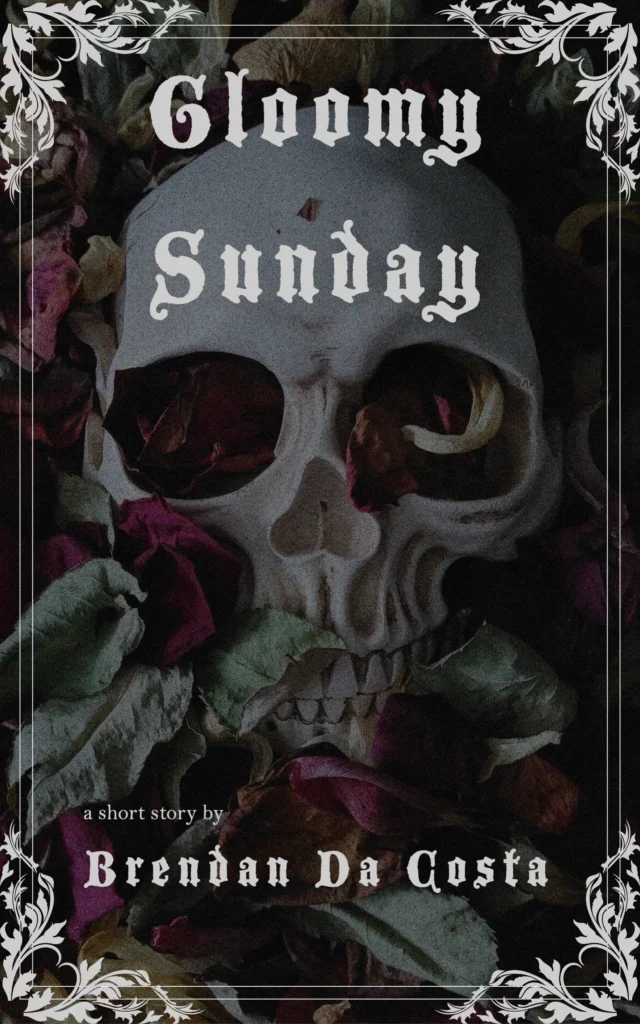
Gloomy Sunday by Brendan Da Costa, book cover.

Gothic horror

Gloomy Sunday

Inspired by the song made unforgettable by Billie Holiday, this dark short story explores grief, depression, and the uneasy border between waking and dreaming.

I awake to the sounds of the old house: the wind through the window and the phantom creaks.

This is a house of desolation and despondency, a stone monument to my woeful memories, perched atop a cliff that falls into the clouds. I heave myself from the covers — my body is heavy with sorrow — and open the blinds. There are no leaves on the trees in the yard but autumn isn’t to blame; the trees have long since died where they stood, their bare, bone-white limbs gnarled into unrecognizable shapes. These trees guard the entrance to this house of heartache, the statues carved out of its agony. The wind blows thick billows of fog through their bare branches and I can feel the biting cold of it as a white ringing in my marrow. The branches of the trees don’t move in the breeze. They are the listless, lifeless watchmen of my misery and will admit no reprieve from this anguish — I think they despise me.

A single cloud blankets the sky and makes of it a greyscale, the colour that sits heavy on everything. I don’t know what time it is because there’s no sun in this swirling kaleidoscope of greys and whites and blacks — it could be noon as easily as it could be midnight. It’s Sunday, and all Sundays are grey days now, ever since… since when I can’t quite remember. Time loses all sense and meaning in depression and despair, when days pass like eternities and eternities are condensed into the thin fabric of memory, where the end folds over to the beginning and everything in-between is forgotten.

I turn away from the window and look to the far side of the bed where the sheets are unruffled. I’ve had the bed to myself since that indeterminate time, but I still sleep on only one half. There’s a barrier in that bed like there’s a barrier in my heart, somewhere I won’t let myself go, something I won’t let myself feel. I don’t know quite how long I’ve lived with these barriers because I don’t quite know how long he’s been gone, but I do know that it has been a long time — that inescapable and endless loop of mourning, that thin, porous fabric that has become my memory. It’s an unpleasant thought: the thought of someone passing into memory, fading to a projected image on that fine film, wafery and faint like a ghost that haunts your heart. It is this ghost that reminds me of the sharp pain of loss — the pain that fades away in sleep but has returned with the dawn to churn my stomach and lurch it and lodge it in my throat — and of the dull ache of despair that grips at my lungs and squeezes out the air.

Between the covers

There’s more
in the margins.

For essays and reflections on the world outside the story, head over to the JBO.